iotta
One self-hosted platform to build, test, and run voice AI on your devices — from day-one simulation to a production fleet.



iotta is the server that turns an embedded device into a voice assistant — it receives audio from a device, runs it through a speech-recognition → language-model → speech-synthesis pipeline, dispatches tool calls, and streams synthesized speech back. It is also the development environment the same teams use to build that assistant: the same server runs from pre-hardware simulation, through prototype bring-up, to the production fleet. There is no separate test tool, and no re-integration between stages.
iotta contains no product-specific knowledge — any voice AI product can be built on it without modifying the platform.
Why iotta
- One platform across the whole lifecycle — simulate before hardware exists, then carry the exact behavior forward to the field.
- AI and firmware teams work in parallel against one versioned tool contract.
- Self-hosted, provider-agnostic, observable — one container on a small box, swap OpenAI or local models by config, TLS on by default, safe staged OTA with auto-rollback.
See docs/product.md for the full case, the feature catalog, and a
side-by-side comparison with xiaozhi.
The operator UI
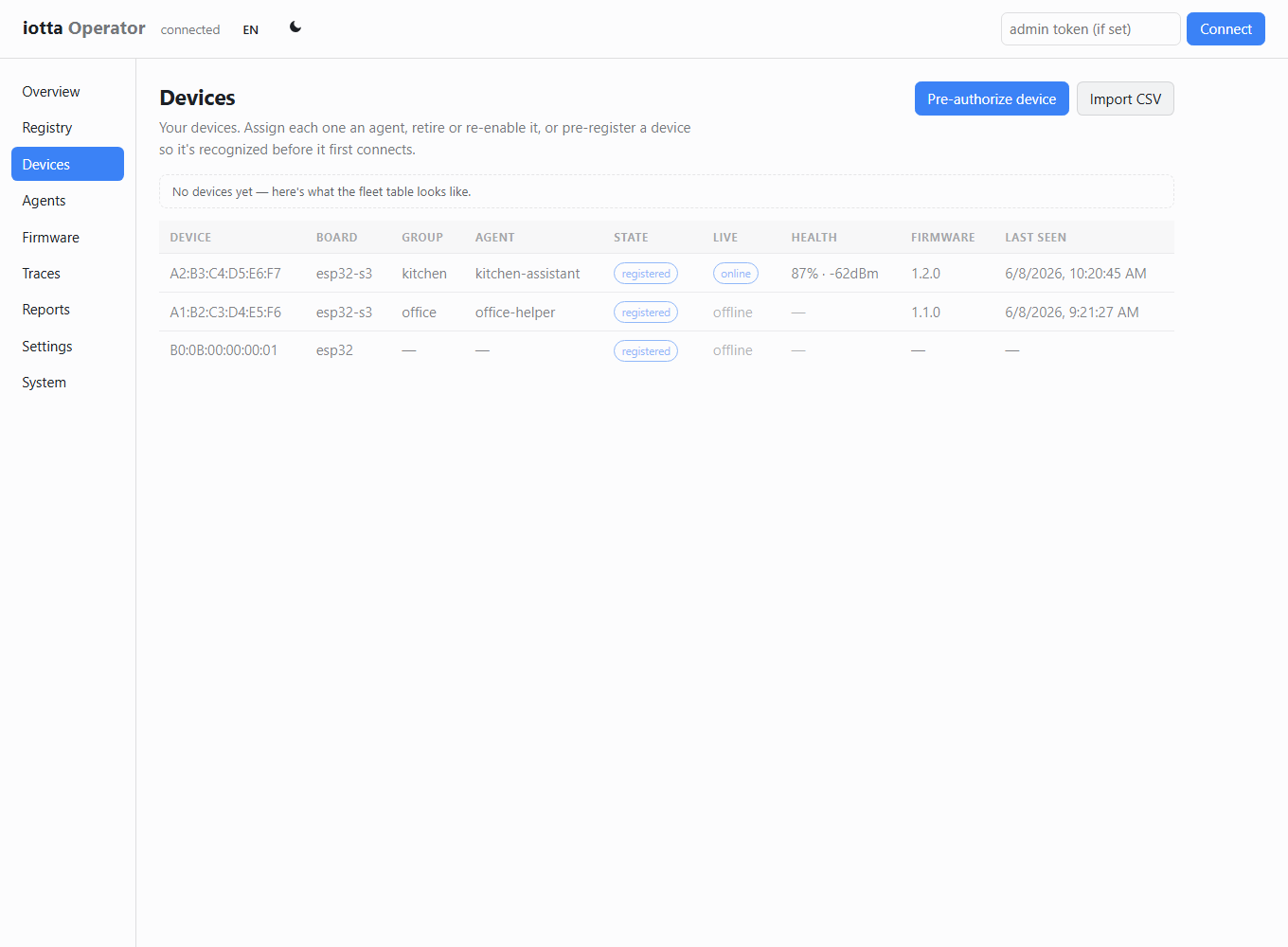
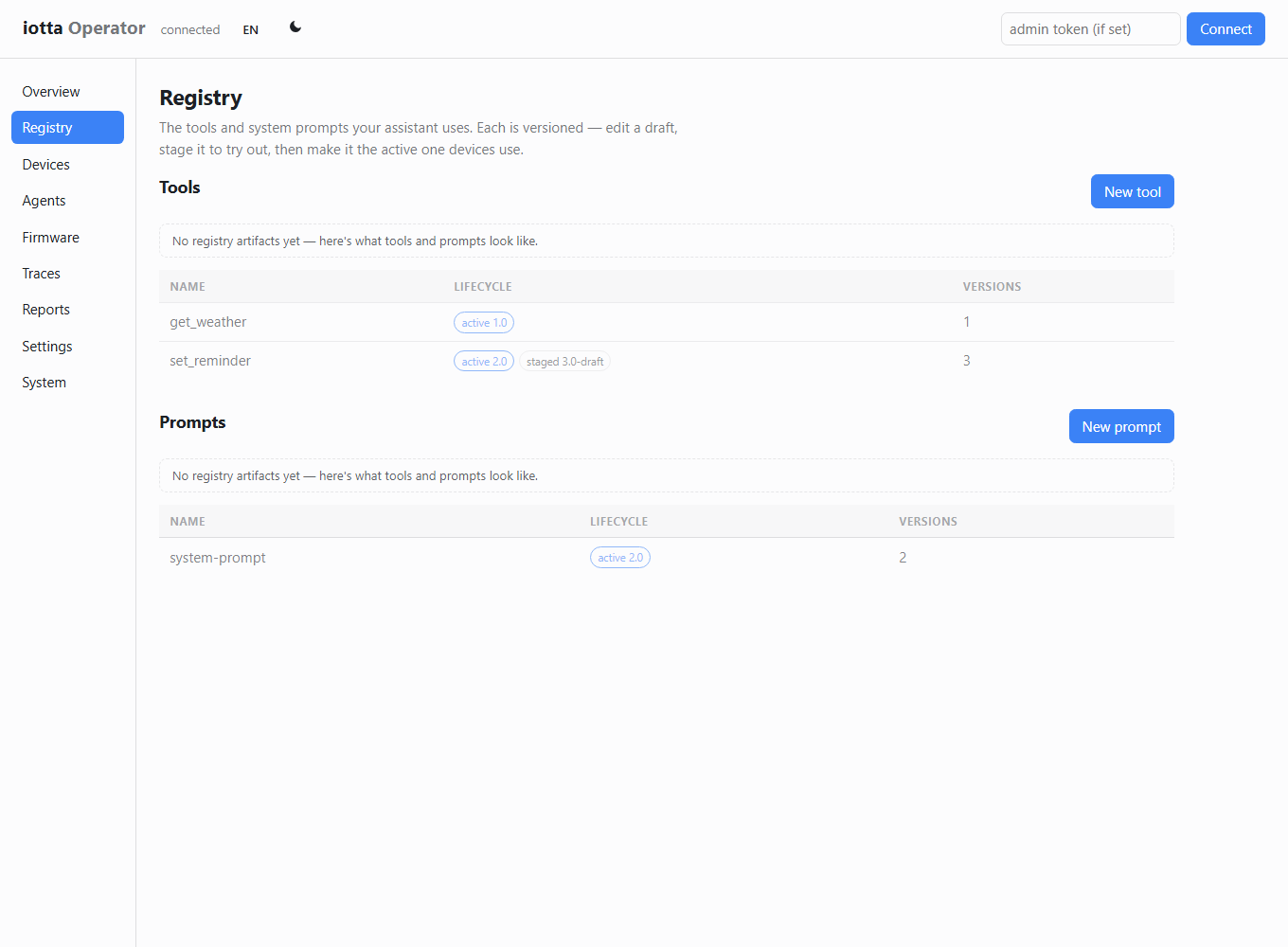
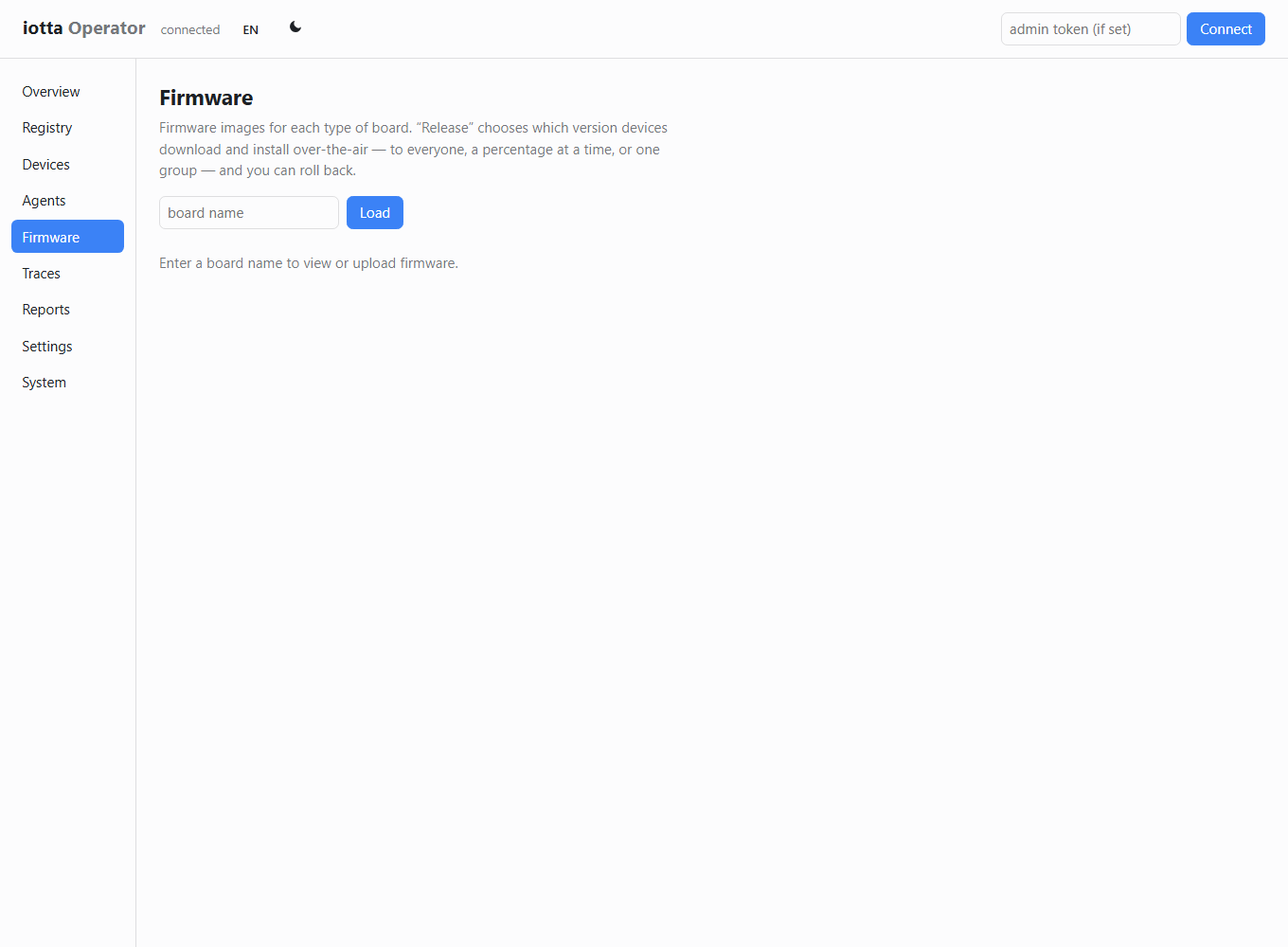
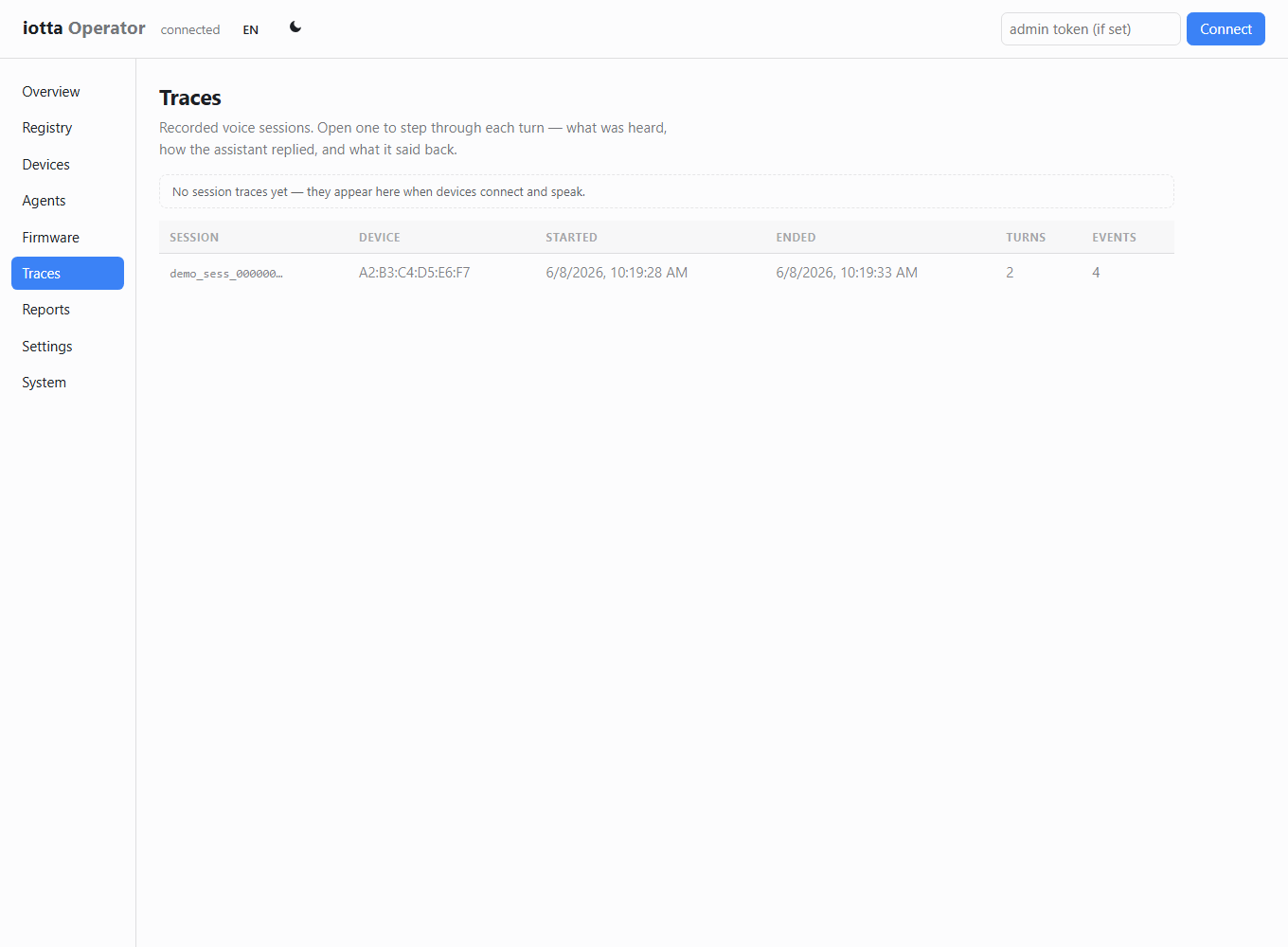
Every administrative operation runs in the browser, served by the platform itself — no separate install. (Screenshots show the built-in empty-state demo content.)
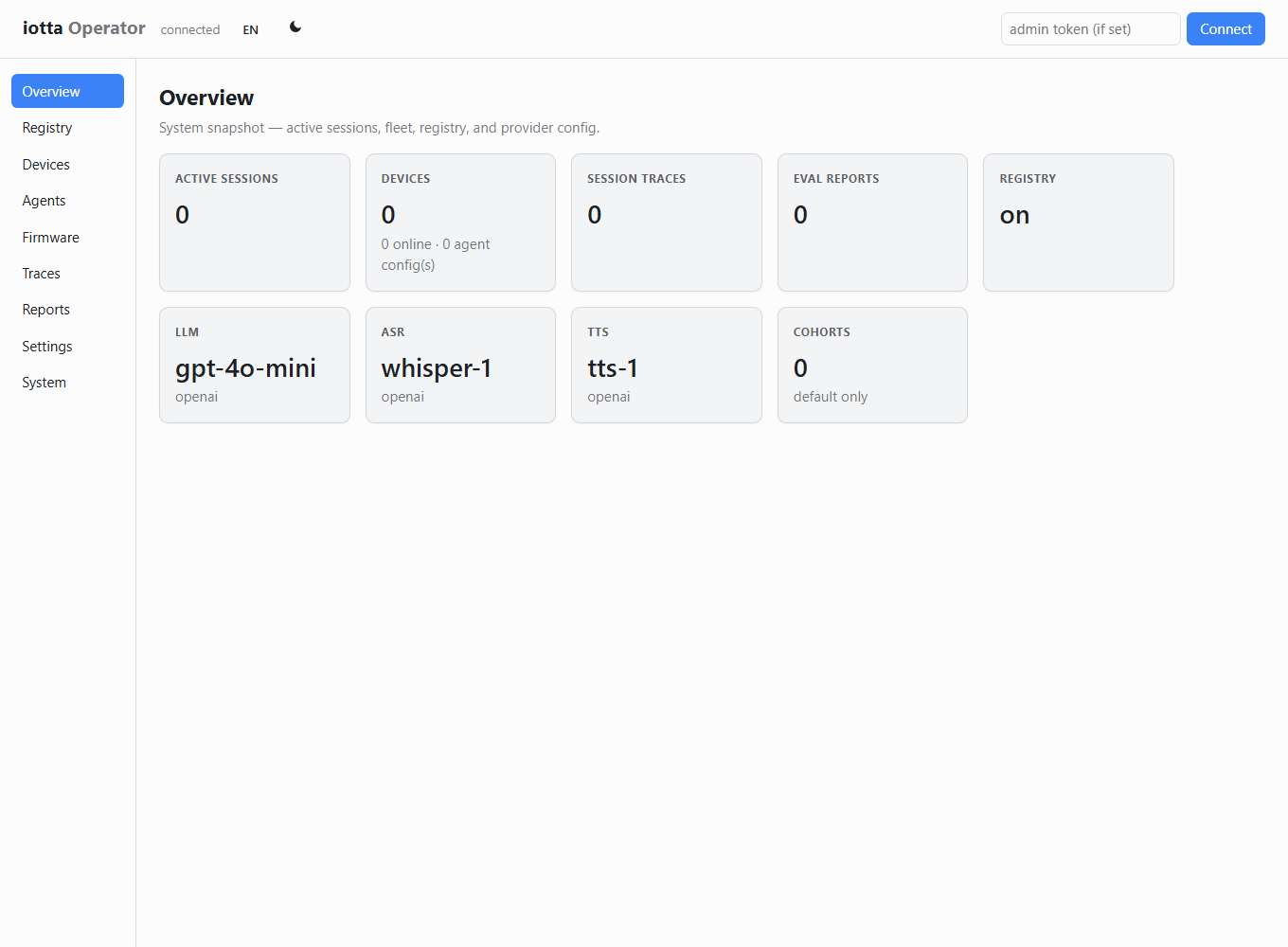
 |
 |
|---|---|
| Devices & fleet liveness | Tool & prompt registry |
 |
 |
|---|---|
| Firmware rollout | Session traces |
Quick start
Docker (recommended)
cp config.example.yaml config.yaml     # edit paths/secrets as needed
cp .env.example .env                    # set OPENAI_API_KEY (and tokens)
docker compose up
The operator UI is then served at http://localhost:8000/ (redirects to /ui).
From source (development)
# System dependencies
apt install libopus-dev libportaudio2   # Linux
brew install opus portaudio             # macOS

# Server
cd server
pip install uv
uv pip install -e ".[dev,audio]"
cp config.example.yaml config.yaml      # fill in your API keys
IOTTA_CONFIG=config.yaml iotta          # serves the API + UI on :8000

# Client (software device simulator)
cd ../client
uv pip install -e .
iotta-client --server ws://localhost:8000/session
Command-line tools
The server package installs operator CLIs alongside the server:
| Command | Purpose |
|---|---|
iotta |
Run the session server + operator UI |
iotta-registry |
Manage tool/prompt versions and promotion |
iotta-eval |
Run scored eval suites |
iotta-devices |
Devices, agents, firmware, OTA rollout/rollback |
iotta-doctor |
Preflight: stores, disk, auth posture, provider keys |
iotta-backup / iotta-restore |
Consistent snapshot ↔ restore (one .tar.gz) |
Environment variables
| Variable | Purpose |
|---|---|
OPENAI_API_KEY |
ASR (Whisper), LLM, TTS via OpenAI (reference provider) |
IOTTA_CONFIG |
Path to config YAML (default: config.yaml) |
IOTTA_ADMIN_TOKEN |
Bearer token gating the /admin operator API |
IOTTA_SESSION_TOKEN |
Shared device session token (per-device tokens also supported) |
Repository structure
server/              # FastAPI session server + operator UI
  src/iotta/         # main package
  src/iotta/web/     # operator UI (static ES modules, no build step)
  tests/             # pytest suite (no external deps required)
client/              # software device client (mic → Opus → speaker)
deploy/              # reverse-proxy examples (Caddy, nginx)
docs/                # design, product, protocol, subsystem references
Tests
cd server
PYTHONPATH=src python -m pytest tests/ -v
Tests run without system audio libraries (opuslib is mocked) and require no network.
Documentation
| Doc | Purpose |
|---|---|
docs/product.md |
What iotta is, for whom, and how it compares |
docs/design.md |
Engineering vision and design principles |
docs/protocol-spec.md |
Wire protocol — normative message reference |
docs/protocol-design.md |
Protocol rationale + firmware port guide (from xiaozhi) |
docs/commercialization.md |
Open-core model, editions, device-cap design |
CONTRIBUTING.md |
How to contribute (incl. the changelog policy) |
CHANGELOG.md |
Release & change history |
Licensing & editions
iotta is dual-licensed open-core:
- Core source — FSL-1.1-ALv2 (Functional Source License): free to use, modify, and self-host, including internal and non-competing commercial use; converts to Apache-2.0 two years after each release.
- Paid edition — a commercial license (activated by a license key) for operating beyond the built-in device cap and using the commercial-only features.
The free Community edition is the full development platform, capped at a small number of
active devices for demos, solo use, and evaluation. See
docs/commercialization.md. The core always runs with no
required cloud dependency.